Signs of learning disabilities
Common signs that your child may have learning differences*:
- Challenges reading and/or writing
- Challenges with math
- Challenges paying attention
- Challenges following directions
- Challenges telling time
- Challenges staying organized
- Poor memory
- Clumsiness
*These signs alone are not enough to determine a learning disability. Only a professional can diagnose these.
Your child may also experience:
- Acting without thinking about possible outcomes (impulsiveness)
- “Acting out” in school or social situations
- Difficulty staying focused; being easily distracted
- Difficulty saying a word correctly out loud or expressing thoughts
- Problems with school performance from week to week or day to day
- Speaking like a younger child; using short, simple phrases; or leaving out words in sentences
- Having a hard time listening
- Problems dealing with changes in schedule or situations
- Problems understanding words or concepts
Why is LD schooling is so crucial?
Students with language-based learning differences struggle in traditional classroom settings that have a “one-size-fits-all” curriculum. Brilliant, neurodiverse children have their own learning DNA that requires a tailored approach to reading, writing, and math. Being wired differently requires innovation and creativity and each lesson can be different for each child.
Before realizing that your child learns differently, you’re fighting to keep your child’s “head above water” with additional tutoring and therapy. Often, there is no time for extracurricular activities like sports and clubs. The stress of not fitting in has a direct impact on your child’s self-esteem and confidence, and raises anxiety.
Your brilliant, out-of-the-box thinker needs a tailored program that challenges, nurtures, and supports not only their academic growth but their social, emotional, and personal growth. Your child needs a school where the faculty and staff are trained to recognize and support every child’s learning profile.
A supportive curriculum helps:
- Develop a positive self-image
- Discover meaningful avenues of expression
- Build character and social skills
- Set realistic goals
- Develop resiliency and self-advocacy skills
- Build a foundation for learning and lifetime achievement
How Park Century supports these goals:
- Smaller classes
- Lower student-to-staff ratio
- Teachers extensively trained and educated to work with students who learn and think differently
- Staff specialists include speech-language pathologists and psychologists
- Tailored and strategic programming for every child
Parents can help their children achieve success by encouraging their strengths, knowing their weaknesses, understanding the educational system, working with professionals, and learning strategies for dealing with specific difficulties.
Early intervention improves a child’s confidence and helps them develop strategies that will enable them to be successful in school.
The research on learning disabilites (LD)
Enacted in 1975, the Individuals with Disabilities Education Act (IDEA) protects students with learning differences. IDEA is also the source of much research, including its recent study* of 7.3 million eligible students during the 2021–22 school year. Of those 7.3 million students:
32%
have a disability that hinders understanding or using spoken or written language
19%
have speech or language impairment
12%
have autism spectrum disorder
Source: National Center for Education Statistics. (2023). Students With Disabilities. Condition of Education. U.S. Department of Education, Institute of Education Sciences. Retrieved [date], from https://nces.ed.gov/programs/coe/indicator/cgg.
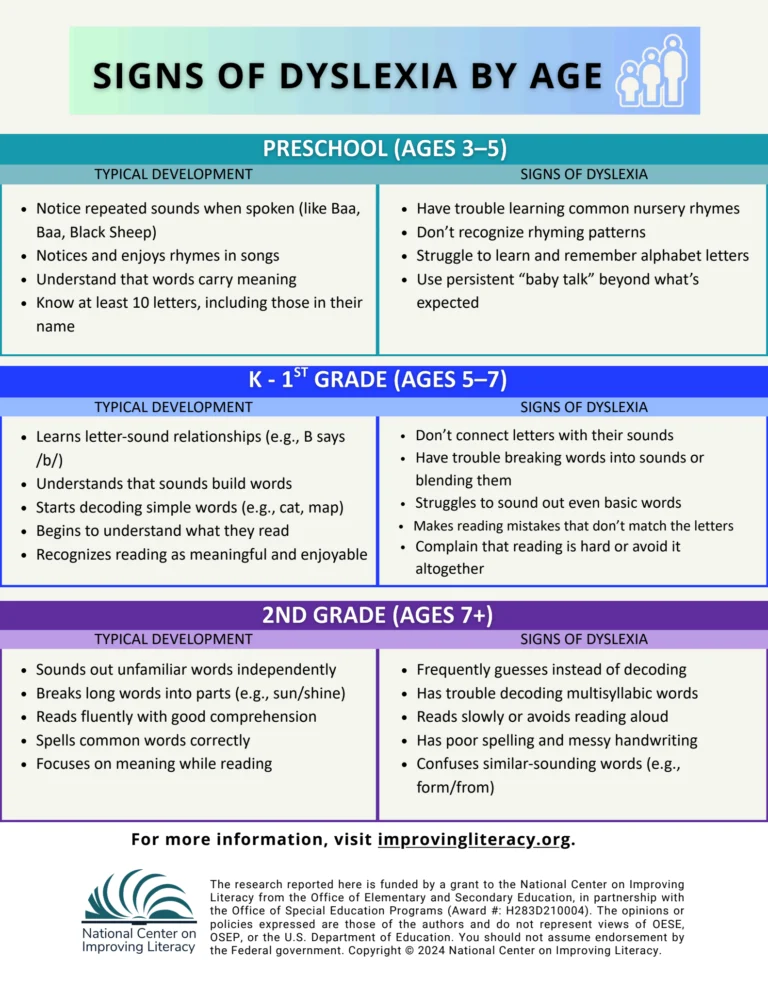

Online resources and book recommendations
We hope to educate and spread awareness about these commonly misunderstood diagnoses and provide helpful articles for parenting in the digital age.
Parent/Guardian Book Recommendations:
- The Dyslexic Edge: Unleash the Power of Thinking Differently by Jamie Waller
- Overcoming Dyslexia by Sally Shaywitz
- The Sound of Hope by Lois Kam Heymann, MA, CCC-SLP
- Thinking Differently by David Flink
- Reader Come Home by Maryanne Wolf
- Explicit Instruction by Anita Archer
- Basic Facts about Dyslexia & Other Reading Problems by Louisa Moats
- Learning Outside the Lines by Jonathan Mooney and David Cole
- The Short Bus; A Journey Beyond Normal by Jonathan Mooney
- Not What I Expected: Help and Hope for Parents of Atypical Children by Rita Eichenstein, PhD
- Differently Wired: Raising an Exceptional Child in a Conventional World by Deborah Reber